- Author
- Pom Arnold
- Published
- Updated
How tough is microcement, really? A personal stress test
“A floor that cannot keep up with life is not a good floor.”
Specifications tell you a lot, but daily life tells you more. Our handfloated coarse quartz microcement floor is in our own living room and bathroom. Not as a showroom, but as a family home. The difference with a controlled test is significant. What follows is not a sales pitch, but an honest account of how our floor holds up under daily family use.
The dog
We have an Old English Bulldog weighing around 35 kilograms. Not a small dog, and certainly not a calm one. When a ball flies across the living room, he sprints after it, nails scraping across the floor at full force. With every turn, every braking action and every acceleration, those nails grip into the surface.
The result on our hand-floated coarse quartz floor after years of use: in normal daylight, we see no scratches from the dog. Floor 1, dog 0.
That is our observation in this home, with this finish and this use. It is not a laboratory test or a promise for every microcement floor. Product choice, texture, sealer, maintenance and point loads all affect how a floor holds up.
The children
Our two daughters, aged five and seven, take care of the rest. Because our home has no side entrance, my eldest daughter's BMX, complete with metal pegs, comes in through the front door. The metal pegs, designed for stunts, are not exactly floor-friendly. But setting it down gently is not an option. The bike is ridden inside and parked somewhere in the hallway. Her heavy stunt scooter follows right behind.
Then there is the daily play: building blocks falling, toy cars racing across the floor, paint and glue spilling. It shows how our floor deals with unpredictable daily use, but it does not replace a standardised material test.
Chairs without felt pads
Then there are the Tripp Trapp chairs. Solid beech, sturdy and heavy. The girls are not yet strong enough to lift them. So the chairs get dragged through every room in the house, across the microcement floor to the dining table, to the kitchen counter and back again. The felt pads disappeared long ago.
Here too, we are describing only what we see on our own floor: so far, the dragging has not left clear scratch lines. We do not turn that into a general comparison with every hardwood floor, tiled floor or other microcement finish.
Why it works
The wear resistance of a Forcrete finish depends on the selected product, texture, sealer, application and use. Our floor is hand-floated coarse quartz and is maintained according to the guidance for that finish.
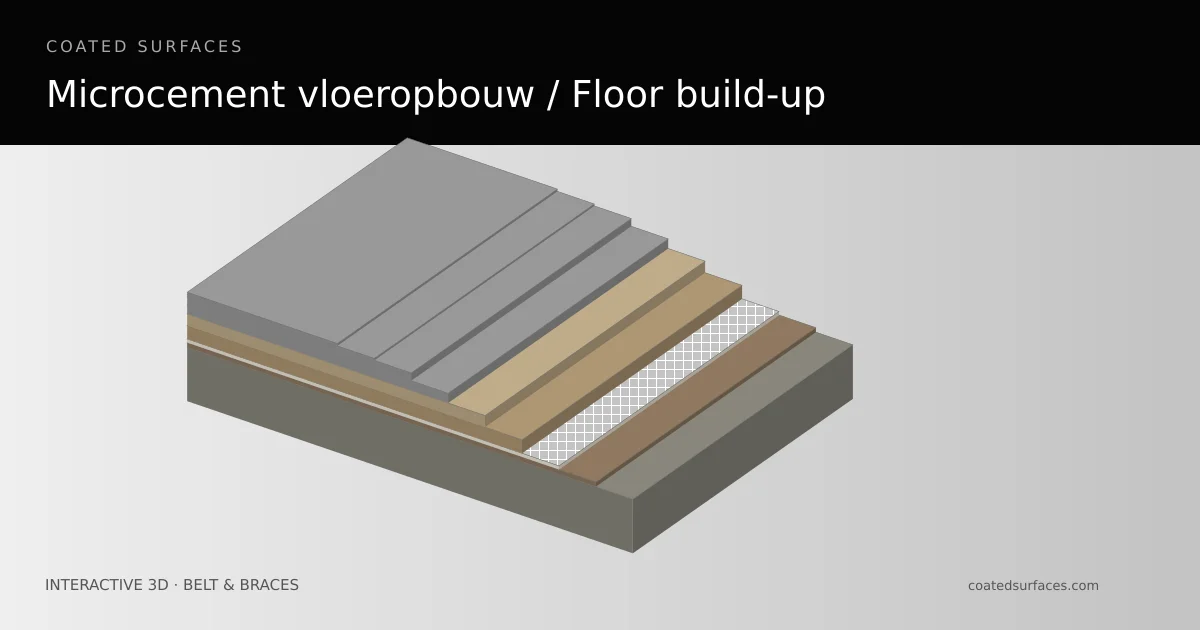
The substrate and complete layer build-up matter too. Our experience with this floor therefore cannot automatically be applied to another room, finish or load.
Technical background
Wear resistance depends on the product, texture and selected sheen. Forcrete specifically describes the diamond-polished Micro-Quartz finish as MOH 7.5 and states that its matt finish is more susceptible to scratching under point loads. Our own floor is hand-floated coarse quartz, so we assess it from the real use documented in this article rather than applying a hardness claim from a different finish.
Slip resistance is a different property from scratch resistance. A wet floor can be slippery; texture, sealer, contamination and maintenance affect the risk. The HSE guidance on slip resistance explains how to assess test data. For a shower or other wet area, the specification must suit the intended use, with test evidence for the selected finish and relevant conditions. Without that evidence, we do not assign a universal PTV value or safety guarantee to every microcement floor.
Our experience
I share this as the person living in the house. After years with a dog, children, bicycles and dragged chairs, we still see no clear scratches on our hand-floated coarse quartz floor in normal daylight. That is relevant practical experience with this floor, not universal proof for every system or household.
If you are considering a floor for intensive family use, our experience can sit alongside the product specification, your selected sample and advice on use and maintenance.
Frequently asked questions
A properly applied microcement floor is designed for long-term use and retains its appearance with suitable maintenance. Exact scratch and wear resistance depend on the selected Forcrete product, texture, sheen and loading. Forcrete publishes a hardness value only for the diamond-polished Micro-Quartz finish; it does not automatically apply to a matt floor. Longevity also depends on substrate quality, installer skill and maintenance after handover. Use a pH-neutral cleaner and follow the care guidance for the selected finish.
Microcement can become slippery when wet. Slip resistance depends on the chosen texture, sealer, contamination and maintenance. A bathroom or shower finish must suit its intended use and wet conditions. Ask for the specification and available test evidence for that exact finish; a test value for another product or texture does not automatically apply to your floor. We discuss this before selecting the material. Proper drainage and suitable maintenance remain necessary. Learn more: Read about microcement bathrooms.
Remove sand and dirt regularly and, after the permitted curing period, use a suitable pH-neutral cleaner according to the care instructions. Avoid abrasives, acids and steam cleaners. Protect the floor with appropriate furniture pads and inspect sealant joints in wet rooms. Signs of use depend on the finish, loading and care; a floor does not automatically stay identical for years. Dirt in the texture may eventually require professional cleaning. Confirm a method suitable for your finish first.
Yes, microcement can crack when the substrate or structure moves. A suitable substrate, proper preparation and reinforcement in the selected system help distribute stress, but do not guarantee a crack-free surface. Existing cracks need investigation, and structural problems must be addressed before finishing. Necessary movement joints remain part of the floor build-up and must not simply be covered over. We assess these points before application and agree the required preparation for each project. Learn more: View the interactive floor build-up.
Yes. Superficial scratches and dull spots can usually be resolved with the right maintenance wax or a fresh coat of sealer: this refreshes the entire surface without reapplying the floor. Local damage can also be repaired. A local touch-up is possible, but that patch stays visible: microcement is applied by hand and a repair never blends seamlessly into the existing work. That is why we prefer to finish a repair per surface or wall. Is a floor due for renewal after years of intensive use? A new top layer can often be applied over the existing microcement, without demolition. Learn more: Discuss your project.
View these projects
Read also
Curious what microcement could do for your project?
Get in Touch