- Author
- Pom Arnold
- Published
- Updated
Microcement in a Dutch rental or apartment: what expats need to know
“Suitable existing tiles can sometimes remain. Agree the preparation, waterproofing details and responsibilities before the work begins.”
Moving to the Netherlands usually means moving into a bathroom someone else chose. Small white tiles, dark grout, a shower screen that has seen better days. If you rent, you may wonder what your landlord will allow. If you own an apartment, the VvE documents may set requirements for wet-room work. Where the existing surfaces are suitable, microcement can sometimes retain them and reduce demolition. This guide walks through what that means in practice for an international renovating a Dutch home: what to agree with a landlord, what to check with a VvE, how long the work takes, and what it costs.
Why microcement suits a rental or an apartment
Microcement is a seamless finish of cement, minerals and resin that is applied by hand as part of a multi-layer system. The finish itself is thin, but the complete build-up height depends on repairs, levelling, reinforcement and the selected substrate. Existing tiles, screed or plaster can only remain when inspection shows that they provide a suitable base.
Where the existing tiles are suitable and firmly fixed, they may remain underneath the new finish. That can reduce demolition and disruption. Repairs, levelling or changes at drains and connections may still be necessary. The complete build-up height must be checked against doors and thresholds before the work is agreed. The work on an average bathroom over suitable existing tiles takes about five working days, with curing time after completion; preparation and detailing can extend that schedule. Our terms specify at least 48 hours before light use, 7 days before water exposure and 28 days before full use, with no standing water during the first 4 weeks. These are not automatic clearance for a first shower: ask us to confirm the product-specific waiting period at handover; a longer waiting period takes precedence.
Forcrete describes its material as waterproof before the sealer is applied. A watertight bathroom also depends on the existing substrate, corners, penetrations and drain connections. For a landlord or a VvE, the complete installation matters: the material alone cannot rule out leaks into the apartment below. We discuss the required preparation and details before agreeing the work.
Renting: what to agree with your landlord
Microcement is not a finish you simply peel off at the end of a lease. Check your tenancy agreement and ask the landlord in writing which permission and conditions apply before commissioning the work.
Give the landlord a clear proposal covering the existing surfaces, required preparation, intended finish and waterproofing details. Keeping suitable tiles can reduce demolition, but it does not make the work reversible or remove the need for permission. A new finish is not a guaranteed increase in property value. Agree the scope and responsibilities in writing before proceeding.
Agree the practical points before anyone starts: who pays, what must happen at the end of the lease and whether compensation has been agreed. Do not assume the landlord will contribute or that the finish may remain without conditions. We are happy to send the landlord the technical details directly, in English or Dutch, and to do the site visit with them present.
Owning an apartment: the VvE
For an apartment with a VvE, the deed of division (splitsingsakte), house rules and decisions can say what you may change and what needs notification or approval. Wet-room work may also affect drainage, shared structures or neighbours, so check the applicable documents rather than assuming an internal finish is exempt.
Check the deed of division, house rules and applicable VvE decisions. Ask the board which approval and documentation are needed for the proposed work, including any requirements for drainage, shared structures or acoustics. We can provide information about the build-up, waterproofing and schedule. Also agree access and working hours: roughening existing tiles creates noise, and the preparation time depends on their condition.
What the work looks like, day by day
Day one is preparation. We check every tile, fix anything loose, roughen the glaze with a grinding machine and vacuum the room. Then the epoxy primer goes on. It seals the surface and fills the grout lines so the wall and floor become one flat plane. In the shower we set the slope towards the drain by hand, accurate to the millimetre.
Days two and three are the structural layers: 160 grams per square metre fibreglass reinforcement embedded in FORPRIME-HB, followed by a second FORPRIME-HB base coat. Each layer has to cure before the next one goes on, which is why we plan the days back to back.
Days four and five are the finish: two hand-trowelled layers of microcement in your colour and texture, then the sealer that protects against soap, limescale and stains. Curing continues after the last coat. Our terms specify at least 48 hours before light use, 7 days before water exposure and 28 days before full use; no standing water is allowed during the first 4 weeks. Confirm the product-specific waiting period with us before the first shower. Where the finish requires a longer wait, that period takes precedence. We protect the rest of the apartment with dust screens and leave the bathroom clean.
What it costs and what is included
A microcement bathroom starts at 180 euro per square metre excluding VAT, including material and application of the system. Preparation is charged separately where needed, and we apply a minimum project fee of 3,000 euro. Walls count as square metres, and a bathroom has a lot of wall, so a compact 3 by 2 metre bathroom with the walls finished to the ceiling adds up to roughly 25 to 30 square metres. The final quote depends on the condition of the substrate, the preparation, detail work such as niches, a shower channel or an integrated vanity, and the total surface.
After the site visit you receive a fixed-price quote in English that lists exactly what is included. Compare it with a tiled renovation project by project. If the existing tiles are suitable and can remain, microcement may avoid demolition, rubble removal and a new screed. If repairs or removal are needed, those items belong in the scope and price.
A checklist before you say yes
- Rent: written permission from the landlord, and an agreement on who pays and what happens at the end of the lease.
- Own: check the VvE house rules for wet rooms and working hours, notify the board, and share the specification.
- Ask how the complete shower is made watertight, including the substrate, corners, penetrations and drain connection. A waterproof material does not replace correct detailing or maintenance.
- Ask for a fixed price and for the quote to state what is included.
- Arrange somewhere to shower while the finish cures. Our terms distinguish light use, water exposure and full use; confirm the product-specific release time with us before using the shower, and allow for a longer wait if required.
- Keep the specification and the invoice. If you sell or move out, the next owner or your landlord will ask for them.
If you want to see what a finished room looks like, our bathroom in Rotterdam-South is 33 square metres of seamless floor, walls and walk-in shower over what used to be a tiled bathroom. The full build-up, the comparison with tiles and the frequently asked questions are on our microcement bathroom page. And if you would rather just ask, send us a few photos and the dimensions. We reply in English.
Frequently asked questions
Yes, Forcrete describes its microcement system as waterproof before the sealer is applied. That is a material property, not a guarantee that every finished shower is automatically watertight. The substrate, corners, penetrations and drain connection must be suitable and carefully detailed. The sealer remains part of the finish and protects against soiling and wear. We assess the complete build-up for use in a bathroom or shower. Learn more: Read about microcement bathrooms.
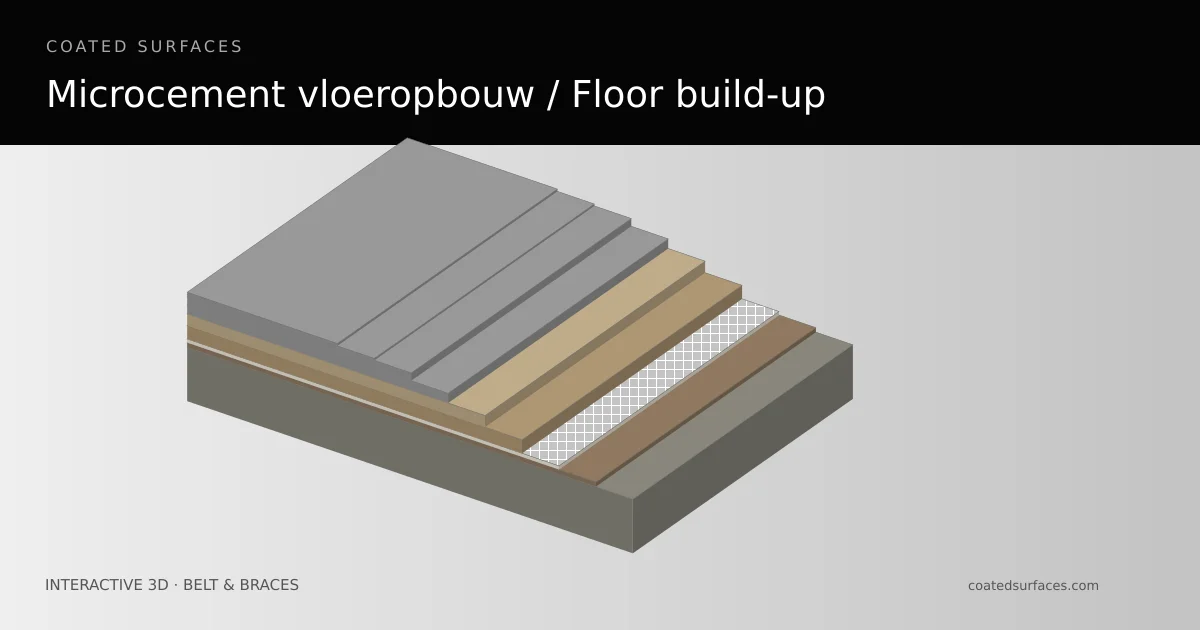
Microcement can be applied over existing tiles when the tiled floor is suitable, stable and firmly fixed. We first check adhesion, cracks, grout lines, levelness and residual moisture. If the substrate is suitable, the tiles are roughened with a grinding machine to remove the glaze layer. We then apply the specified primer and preparation, followed by a 160 g/m2 reinforcement mesh in a scratch coat, the High Traffic Base XT and the chosen finish. Repairs or additional levelling may still be needed. When the existing tiled floor can remain, this can reduce demolition work. Learn more: View the interactive floor build-up, Read about microcement bathrooms.
A standard floor project takes an average of five to seven working days, depending on the surface area and complexity. This includes substrate preparation, primer, reinforcement mesh, scratch coat, multiple layers of microcement and the final sealer. Each operation follows the specified drying and recoating times. A bathroom typically takes five working days. It is smaller, but takes more time per square metre because of waterproofing and detailing around drains, niches and connections. Curing after completion is additional. Our terms specify at least 48 hours before light use, 7 days before water exposure and 28 days before full use. No standing water is allowed on the floor during the first 4 weeks. These periods do not replace the product-specific maintenance protocol. Ask us to confirm the waiting period for your finish before water exposure; a longer product-specific waiting period takes precedence.
The thickness of the microcement finish is not the same as the complete floor build-up. Preparation, repairs, levelling and the selected base system can add height. Agree the complete build-up for your substrate and check doors, skirting and adjoining floors. Our interactive floor guide explains the components; the illustrated thicknesses are schematic. Learn more: View the interactive floor build-up.
Microcement starts from 140 euros per m2 for floors and from 180 euros per m2 for walls in wet areas such as bathrooms and showers. The final price depends on the condition of the substrate, the complexity of the space and the total surface area. A floor that requires additional levelling takes more time and materials, and a bathroom with many corners and niches demands more work than an open living floor. For larger projects we offer volume discounts: the more m2, the lower the price per m2. The price per m2 includes material and the application of the complete system. Preparation is charged separately: levelling a tiled floor 15 euro per m2, levelling a bathroom 60 euro per m2, stripping and roughening tiles 500 euro per project and 250 euro per niche. We apply a minimum project fee of 3,000 euro. All amounts exclude VAT. Our pricing page lists every rate with two worked examples. Learn more: View all rates and worked examples.
Remove sand and dirt regularly and, after the permitted curing period, use a suitable pH-neutral cleaner according to the care instructions. Avoid abrasives, acids and steam cleaners. Protect the floor with appropriate furniture pads and inspect sealant joints in wet rooms. Signs of use depend on the finish, loading and care; a floor does not automatically stay identical for years. Dirt in the texture may eventually require professional cleaning. Confirm a method suitable for your finish first. Learn more: Read our real-world experience of daily use.
View this project
Read also
Curious what microcement could do for your project?
Get in Touch